
Blue Vista Capital Chairman, Law School to Real Estate, Airplane Conversations
This week I spoke with Robert Byron, 1973 College and 1996 Law UVA grad who’s now the Chairman, Co-CEO, and Co-Founder at Blue Vista Capital Management.
The Rundown:
COLD OPEN: Leaving Chicago big law after a year → investing in bigger real estate
TURNING POINT: When the zero-defect standard sends you somewhere new
STEAL THIS: Walk into your boss's office and ask to take something off their desk
INDUSTRY INSIDER: Leadership isn't about calling all the shots
IF I WERE YOU: Talk to the person sitting next to you on the plane
COLD OPEN
How Did You Get Your Start?
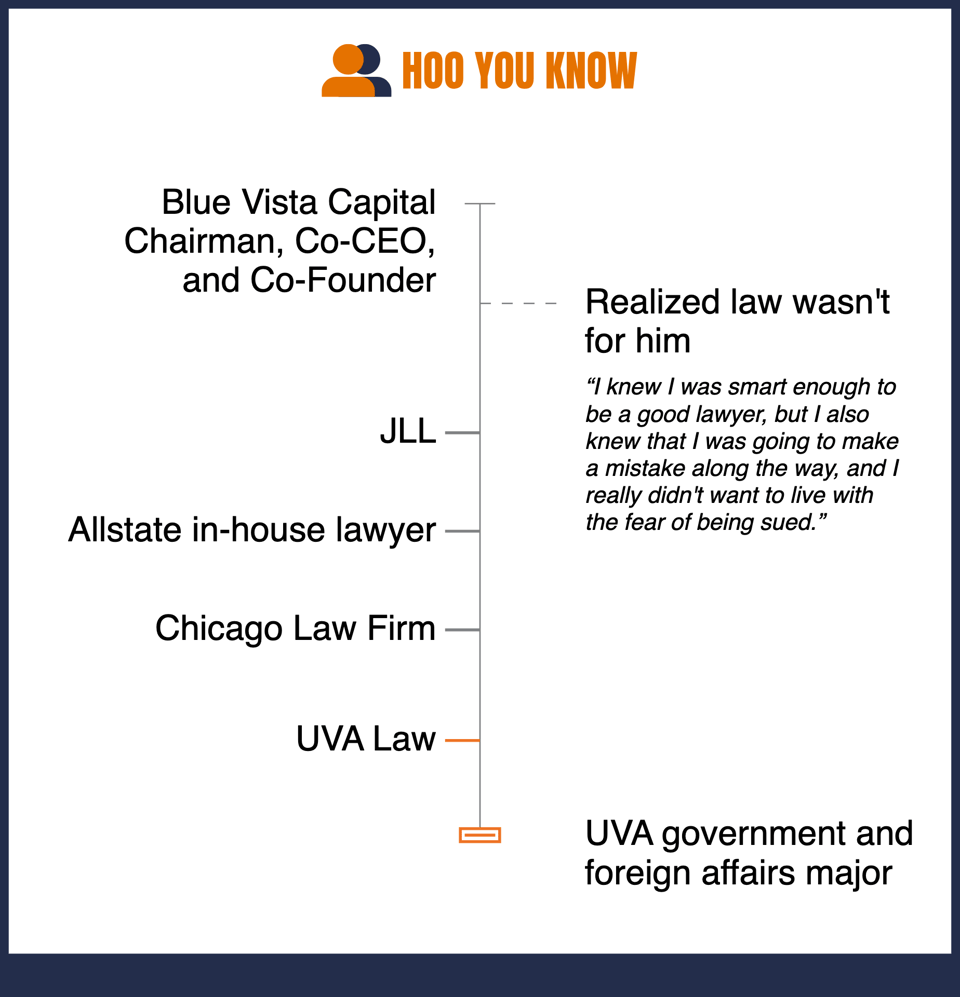
I ended up at the University of Virginia in 1969 as a government and foreign affairs major. I was much more of a reading and writing kind of guy, so I felt a career in law would be well suited to my talents.
I attended the University of Virginia Law School and therefore stayed in Charlottesville for 3 more wonderful years. I went back to Chicago upon graduation and joined a large law firm. I had no idea what that meant, but from law school, it was what I always imagined doing.
Pretty quickly I came to understand that in a lot of large organizations, there's some challenges to being a 1st year associate. Specifically, the quality of the work I was assigned. At the end of my 1st year, I realized I wasn't making the kind of progress I had wanted to and was asked by a friend at a small boutique real estate law firm if I was interested in joining them.
So, I left “Big Law” after just a year, which was certainly not part of the master plan. The light went on that perhaps life was going to take a different path than I had imagined just a year prior. I stayed at the small firm for 4 years until I realized that I needed to make some mistakes on my own to actually learn.
I left to join Allstate as an in-house lawyer. My real estate investment department colleagues were routinely asking me questions that had nothing to do with the law, but with business matters. Although I reminded them I really wasn't trained to do that, they confirmed my answers were about as good as anybody else's.
I left Allstate when the investment program I was working on was terminated due to a tax law change. I then joined a growing real estate investment firm as the general counsel. After one or two years of trying to get things organized, I recognized that I really wanted to try my hand at doing real estate deals from the investment perspective instead. I asked to be considered for an investment officer job, and never looked back.
My career proceeded through a series of both institutional investment jobs and entrepreneurial ones. I spent the bulk of the 90s at a place called LaSalle Partners which ultimately became JLL, spending the first half of my tenure there on the investment banking side of the business, and the other half on the pension fund management side.
I was beginning to develop some fairly diverse skills and really understanding the wide variety of capital markets available to support real estate. So, I left LaSalle to start an investment banking business at a competitors shop, but that adventure did not turn out because the guy who wanted me to join announced that he had an internet dream that he was going to pursue and left the firm just a few months after I arrived so I had to scramble. I came back to Chicago and convinced my partner from the LaSalle days to basically get the band back together again.
We started Blue Vista in September of 2002. Today, it's a boutique real estate investment management business, and we raise capital from institutional investors, and then pursue niche investment strategies in the US and a little bit in Canada.
TURNING POINT
What’s A Challenge You Faced Early On?
Early on, having gone to school for all those years, but not really understanding what it meant to practice law and earn a living — not having connected the dots between practicing corporate law and the business or business in practicing law.
There are some inherent challenges in practicing law, which I didn't fully appreciate such as lawyers get paid by the hour. They're only 24 of them in any day, and that wasn't going to change.
Also, lawyers are held to a zero defect standard. If you make a mistake in the real world you, agonize over it, but you ultimately get out your checkbook and try to solve the problem. If a lawyer makes a mistake, the client asks to see your malpractice insurance policy! I knew I was smart enough to be a good lawyer, but I also knew that I was going to make a mistake along the way, and I really didn't want to live with the fear of being sued.
So I slowly gravitated towards the business side and then figured out how to overcome my natural aversion to numbers as it’s necessary to becoming a successful business person. You have to assess risk from a different perspective.
STEAL THIS
What’s A Question You Love To Be Asked (Or Asking)?
The one question I enjoy being asked is “What are good ideas to start a career successfully and launch yourself into the ecosystem?”
When one starts his or her career, I've always said that there is nothing like working hard and showing up. These are pretty obvious, but not everybody practices them.
Show up before the boss gets in and stay until they go home. Take on new work with a smile. Volunteer to take on new work.
Young people do not walk into the boss's office and say to them, is there anything that I could be working on with you, or take something off your desk? Nobody does it. I don't know why. But the 1st person who does it wins because it's just such a notable commitment to self-improvement.
INDUSTRY INSIDER
What Do People Misunderstand About Leadership?
I think the misconception about a leadership role in a boutique investment business is people think you have all the ability to make decisions.
There's a team of people, and sometimes people work really hard on transactions that you may have some doubts about, and sometimes you have to take into account that you don't have the unfettered ability to do exactly what you want to do.
They're looking to you for guidance and helping them do a better job as a key role. Sometimes being able to exercise your discretion just the way you want to is actually harder than one would imagine.
IF I WERE YOU
Do You Have Any Advice For Students?
I think it's gonna be a quickly changing hiring landscape for people who want to be part of the financial services industry. The AI revolution is at the very earliest stage, but it's going to be dramatic. Either downplaying the advent of AI solutions or being an ostrich, putting your head in the sand, and trying to ignore it is bad.
This is a freight train rumbling down the tracks — it’s not stopping. I've seen just recently some of the power of these AI tools, and they are unbelievable. Young people must become masters of these tools; not casual observers using AI to organize their Spotify playlists.
Another piece of advice I always offer is when you sit down on an airplane, do not turn on your iPhone and start watching some Netflix series. Look around, see who you're sitting next to, and engage in a conversation. It might be impactful in ways you could never imagine.

